


Where the World Ends: A Journey to Península Mitre
- Apr 13
- 3 min read
Summer in Tierra del Fuego feels almost unreal. Daylight stretches deep into the evening, as if the sun refuses to set. In this setting—where the days seem endless—this journey begins from the remote Estancia Moat, heading toward one of the southernmost points of the continent: the Cabo San Pío Lighthouse in Península Mitre.
This is not a trip for watching the clock. It’s a journey to forget about time altogether.
The beginning: a calm that hints at the wild
Arrival at the estancia, around midday, comes without fanfare. A light lunch, the wind descending from the mountains, and a quiet walk toward the shores of the Beagle Channel set the tone for what lies ahead.
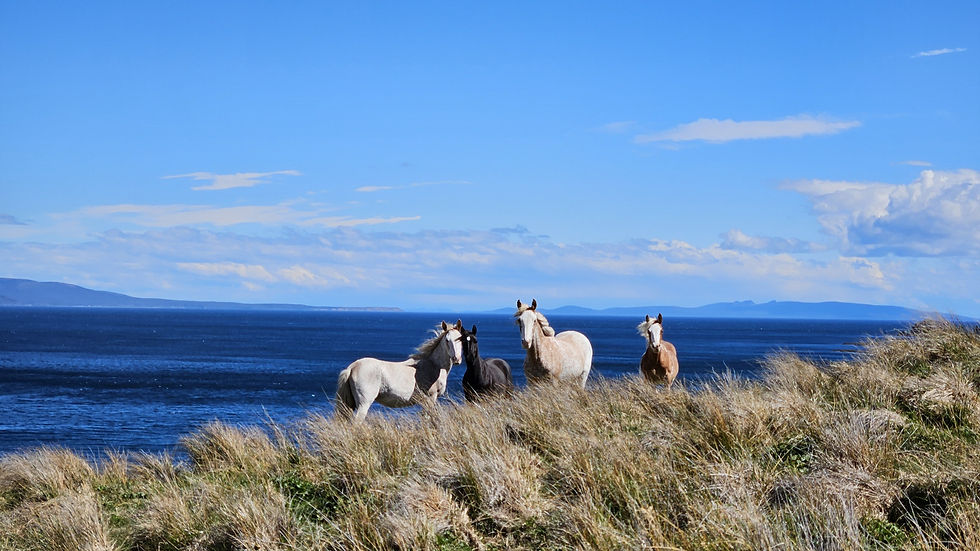
But the most interesting part comes later. Free time is not empty—it’s a process of adaptation. The body begins to understand the rhythm of the place. The mind starts to let go of what isn’t essential.
When night finally falls—or rather, when the clock tells us it should—we gather around a steaming lamb stew. The technical talk isn’t a formal briefing, but a conversation among those who truly know the land. We talk about distances, weather, horses… but above all, about respect.
The first push: entering untracked territory, Península Mitre
The next morning, the cold cuts through—but it awakens. Breakfast is hearty, almost ritualistic. Then, with few words, the ride begins toward Península Mitre.
Progress is steady. There are no marked trails, only natural references. The terrain shifts constantly: wetlands that absorb every sound, forests that close in around the path, beaches where the wind blows without restraint.
Time moves differently on horseback. It doesn’t feel long, but it feels intense. There’s a moment—perhaps while stopping for lunch in the middle of nowhere—when the true scale of the distance covered begins to sink in.
Arriving at Puerto Rancho after six to eight hours in the saddle is more than reaching a point on the map. It’s shelter. It’s warmth. It’s rest. Dinner, simple and flavorful, carries that unmistakable taste that only comes after real effort.
The edge: where the land ends
The third day carries a different tone. There’s a shared feeling, even if no one says it out loud: today, we arrive.
The ride to the lighthouse isn’t necessarily more difficult, but it is more intense. The landscape opens up, more exposed. The wind takes center stage. The horizon expands.
And then, suddenly, it appears.
The Cabo San Pío Lighthouse isn’t striking because of its size, but because of its location. It stands exactly where it should: at the edge. Beyond it, there is nothing.

The day unfolds exploring the surroundings. There’s no rush to leave. In summer, the light lingers for hours, allowing time to stay, observe, and understand. It’s one of those places where silence doesn’t feel uncomfortable—it surrounds you.
Returning to Puerto Rancho that afternoon feels both like coming back and like saying goodbye.
The return: a different way of seeing
The journey back to the estancia doesn’t repeat the experience—it transforms it. The same landscape, traveled in reverse, feels different. Perhaps because you are no longer the same.
The pauses become more intentional. The fatigue is there, but it doesn’t weigh you down. There’s a kind of clarity that emerges when everything unnecessary falls away.
Arriving once again at Estancia Moat, as the long summer afternoon stretches on, feels like a perfect ending. The asado awaits as a quiet celebration. There’s no need to say much. Everyone understands what has just been lived.
The ending that isn’t an ending

The final day begins unhurried. The body, still attuned to the rhythm of the journey, moves more slowly. Breakfast lingers, the morning is savored.
And then, the water takes center stage once again.
Boarding from the shore marks the beginning of the return to Ushuaia along the Beagle Channel. But far from being a simple transfer, it becomes an epilogue worthy of the story.

Humpback whales appear without warning, breaking the surface with an elegance impossible to replicate. Further along, Martillo Island concentrates life in its purest form: gentoo and Magellanic penguins, clumsy on land yet precise in the water.
Passing by the Les Éclaireurs Lighthouse signals that the known world is near. Sea lions rest on the rocks, while cormorants challenge the wind.
And finally, Ushuaia comes into view.
More than a journey
There are experiences that can be explained. This is not one of them.
Because it’s not just about riding, or reaching a lighthouse, or seeing wildlife in its natural habitat. It’s about having been part—even if only for a few days—of a place where nature still has the final say.
At the end of the world, when summer stretches the days to their limit, you come to understand something essential: time isn’t measured… it’s lived.


Comments